I am not Fronteriza, but I come from border people.
Derivative of the place name “Aintab” also called “Gaziantep,” a border city across from Aleppo in Northern Syria, my surname, “Antebi,” is rooted in borderism. This complexity of identity rooted in place is part of my family history, my name, and ultimately, my relationship to the Mexico/United States border. In recent years both borderlands have taken center stage in the dehumanizing treatment of political and climate refugees. This film has a lot to do with bearing witness when the gaze is obscured.
I was raised in the borderlands of El Paso and Ciudad Juárez. In the years since I graduated from high school in 1993, I watched the two cities, that once shared the same name and continue to share community, become increasingly dissected by federal political, social, economic, and environmental policies designed to obstruct the movement of people, culture, and the river with two names.
In 2015 I received a generous film/video grant from the Jerome Foundation which initiated the production of this film. I knew that I wanted to trace the roots of colonial treaties, policies, and personal history to better understand this contemporary moment.
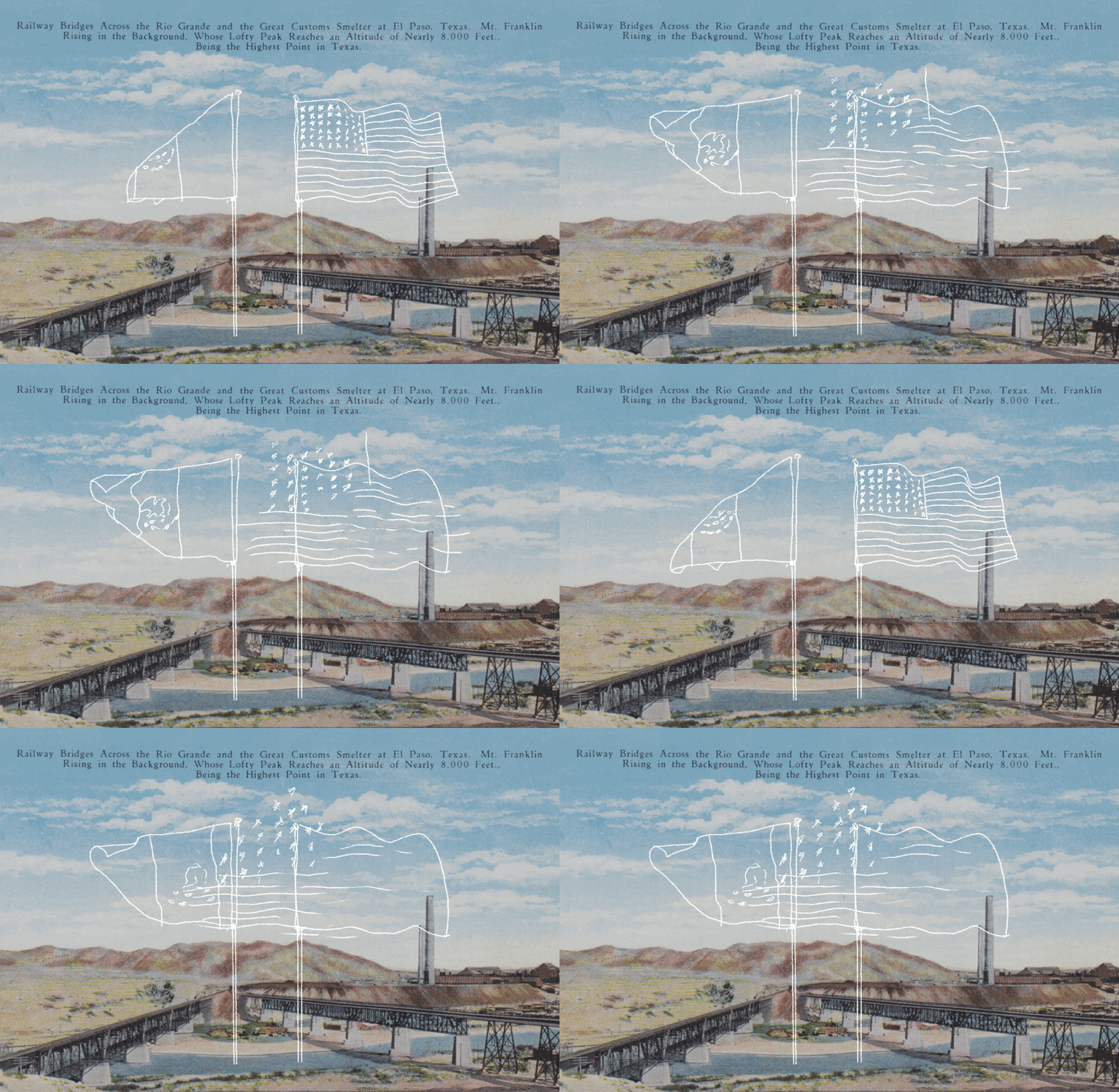
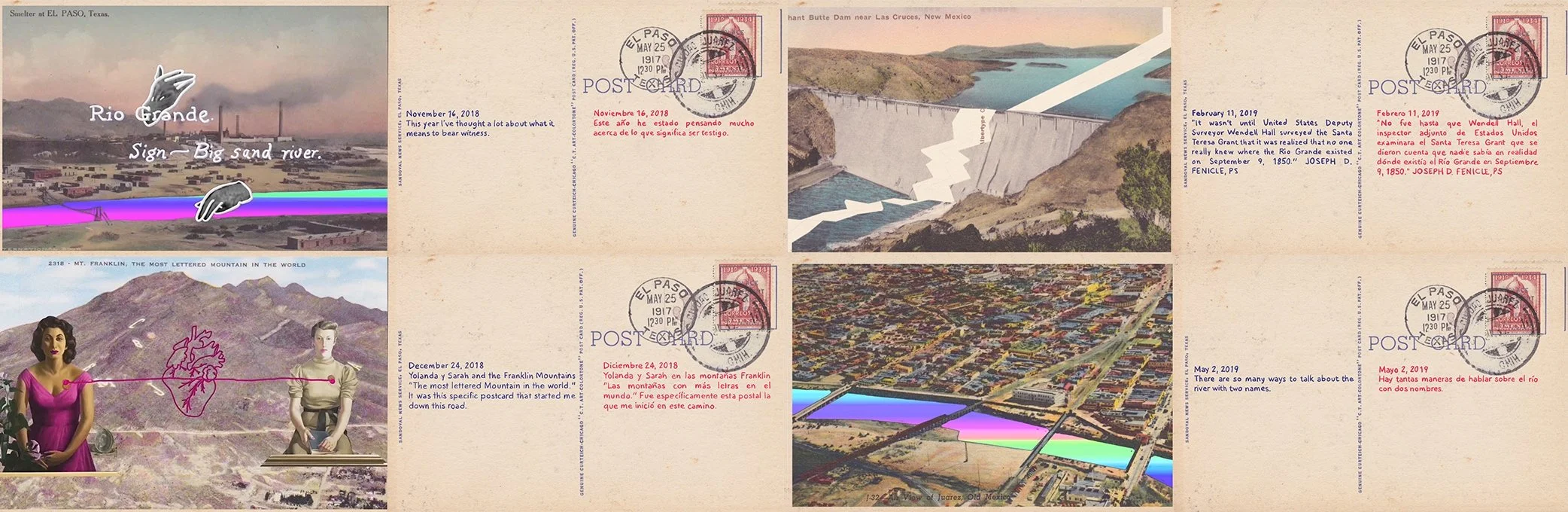
In my work I have returned to the postcard as an object, an indexical document—that is almost always out of sync or time or tone with the moment at hand, as well, a type of open letter. When I began this project I purchased a vintage linen postcard on eBay of the Franklin Mountains with the caption “The most lettered mountain in the world.” This unencumbered image of the blocky letters assembled from painted rocks scattered across the mountain, the backdrop of my young adulthood, got me thinking about the graphic language of the mountains that comprised El Paso Del Norte/The Pass of the North.
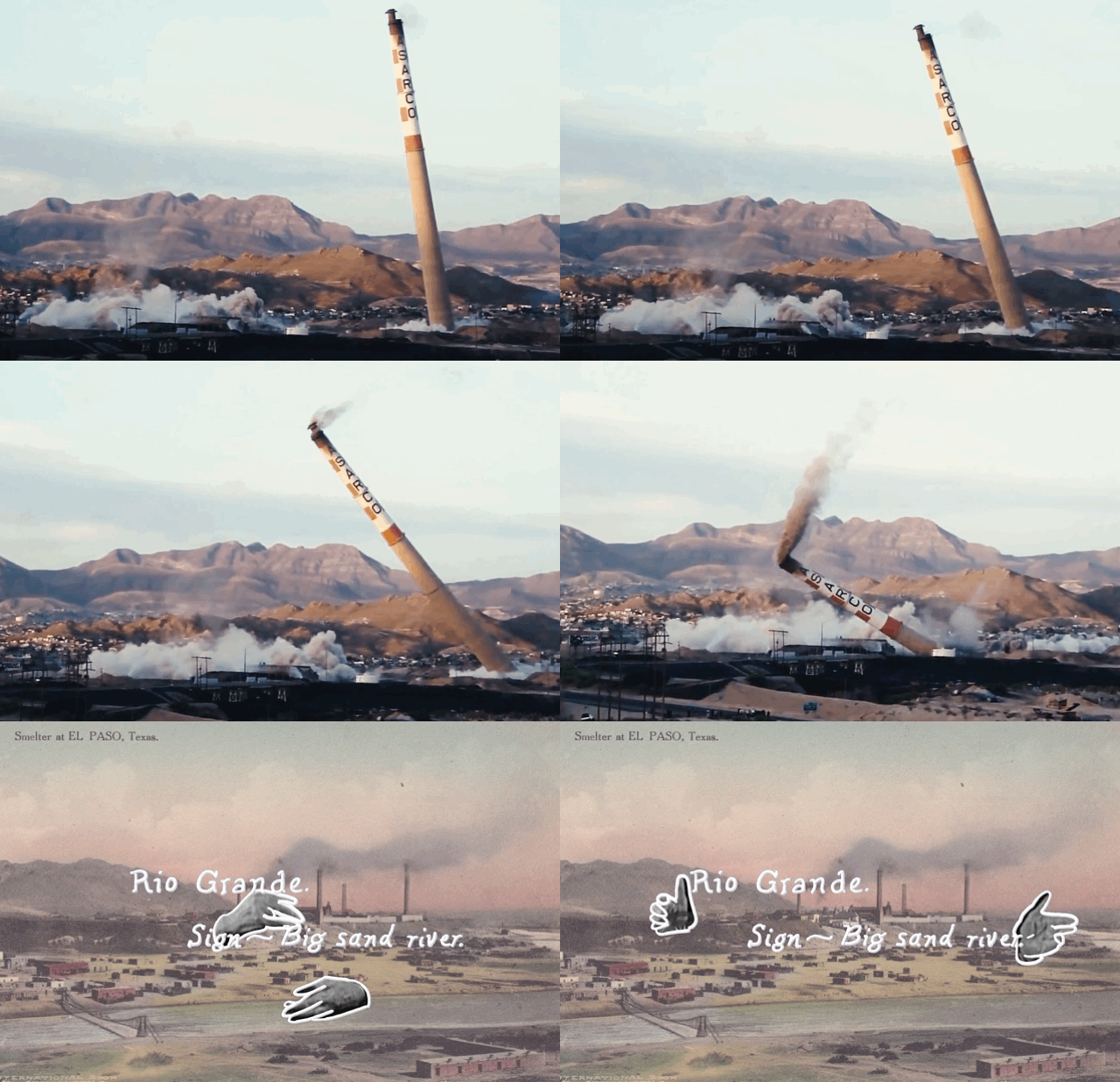
I began collecting more vintage postcards from the late 19th century through the early 1970s. The accumulation of these images were a way to track perspectives and changing notions of when and how the border was constructed and what constitutes a monumental image meant to entice tourists to visit these places. The postcards also enabled me to respond, reflect, and interrogate the question of "what and for whom is a monument" and “how can monuments or monumentality also double as memorials?”
Gloria Anzaldúa, the renowned scholar, poet, auto historian, and the first academic to broach the topic of border theory, uses the Nahuatl word Nepantla to talk about the liminal space of binaries (geographic, cultural, gender, language, etc.) or in-betweenness. This space of transition or transgression or morphing offering the possibility of new-hybridizations and meaningful bridges similarly to the way in which an animation is formed by creating continuity between frames (also called in-betweens). I also acknowledge the construction of borders is the very conditions that make Anzaldúa's person and work possible. And similarly the space between frames is the very place where the persistence of vision occurs and connects and activates the continuity of two separate places.
Two constraints informed my process in assembling this film. One was the idea of a film entirely composed of transitions—the basis for the first half of the film. And the second constraint was only to collaborate with people from the borderlands region. In the process of collecting hundreds of iconic postcards from El Paso/Juárez, I discovered that my childhood friend, Claudia Muñoz Helming 's abuelito, Roberto López Díaz, authored the majority of tarjeta postales between 1950-1980 and as such became Chihuahua's most prominent postcard maker in Juárez, Chihuahua, and Mexico, and possibly one of Mexico’s premiere documentarians.
El Paso and Juárez share history, share people, share each other's gaze, their differences are constructed by imperialist treaties and policies, and obstructions that insist on their difference.
Screenings:
2025
Contested Realities: From Field Work to Form, forthcoming screening and workshop at Union Docs, Brooklyn, New York, 2025 (With Cathy Lee Crane, Jason Livingston, and David Taylor)
·Screening at The Falstaff, El Paso Texas (Programmers: Celina Galicia and Xingaderas)
·Video Art Night (VAN)!, AT&T Discovery District, Dallas, Texas
2024
·Acquired for The El Paso Museum of Art’s permanent collection
·Official Selection 20 Festival Transterritorial de Cine Underground, Buenos Aires, Argentina
Official Selection Cinetoro Experimental Film Festival, Toro Valle del Cauca, Columbia
Solo exhibition at Galeria Cinco Puntos, El Paso, Texas
·Screening followed by a Q & A at the Irish National College of Art and Design Dublin, Ireland 2023
·Included in the Border Biennial at The El Paso Museum of Art. El Paso,Texas
·Included in the Border Biennial at the Museo de Artes de Ciudad. Juárez, Mexico. Curators: Claudia S. Preza M.A., EPMA Assistant Curator, alongside curatorial advisors Edgar Picazo Merino and Jazmín Ontiveros Harvey.
Official selection of 26th annual Antimatter [Media Art], October 19 to 29, in Victoria, BC, Canada.
Official selection of AM Docs Film Festival, Palm Springs, California
2023
Official selection Lunenburg Doc Fest, Lunenburg Nova Scotia Canada
Official selection Oaxaca Film Festival, Oaxaca, Mexico
Official selection of AM Docs Film Festival, Palm Springs, California
Selection MexiCali BiennialThe Land of Milk & Honey / La tierra que mana leche y miel
The Wonder House, SXSW, Austin, Texas
The Arizona Biennial 2023 at the Tucson Museum of Art Curator: Taína Caragol
Official Selection Antimatter [Media Art] Film Festival, Victoria British Columbia
Official Selection Biophilia Film Festival, Texcoco and Oaxaca, Mexico
Border Biennial, El Paso Museum of Art, El Paso, Texas
2022
Soft premiereCentral School Project, Bisbee, Arizona
Cornell Cinema (X)trACTION Program Ithaca, New York
Arsenal Berlin (X)trACTION Program, Berlin, Germany
Rio Grande Theater, Las Cruces, New Mexico in conjunction with Icons and Symbols of the Borderland, curated by Diana Molina